Montpellier Process @COP 16
The Montpellier Process is a collective, community-owned process convened and curated by an alliance of partners whose aim is to demonstrate more effective, more iterative, and better coordinated Science-to-Policy Interfaces (SPIs) across scales (global, national and local), across sectors (environment, health, people, agriculture, food) and across knowledge systems. It adopts Food Systems as an entry point to engage across the feed-care-protect nexus.
-
Through its presence at Biodiversity COP16, the MP had the opportunity to amplify its message: the Feed-Care-Protect nexus challenges will only be addressed when agri-food systems solutions are applied. Food systems transformation best contributes to sustainable development when aligned to the Global Biodiversity Framework and targets just as the targets will only be met if they are incorporated into Food Systems strategies and pathways. This takes effective and inclusive science-policy-society interfacing spaces, starting from where the implementers are, so that knowledge communities can play an authentic role.
-
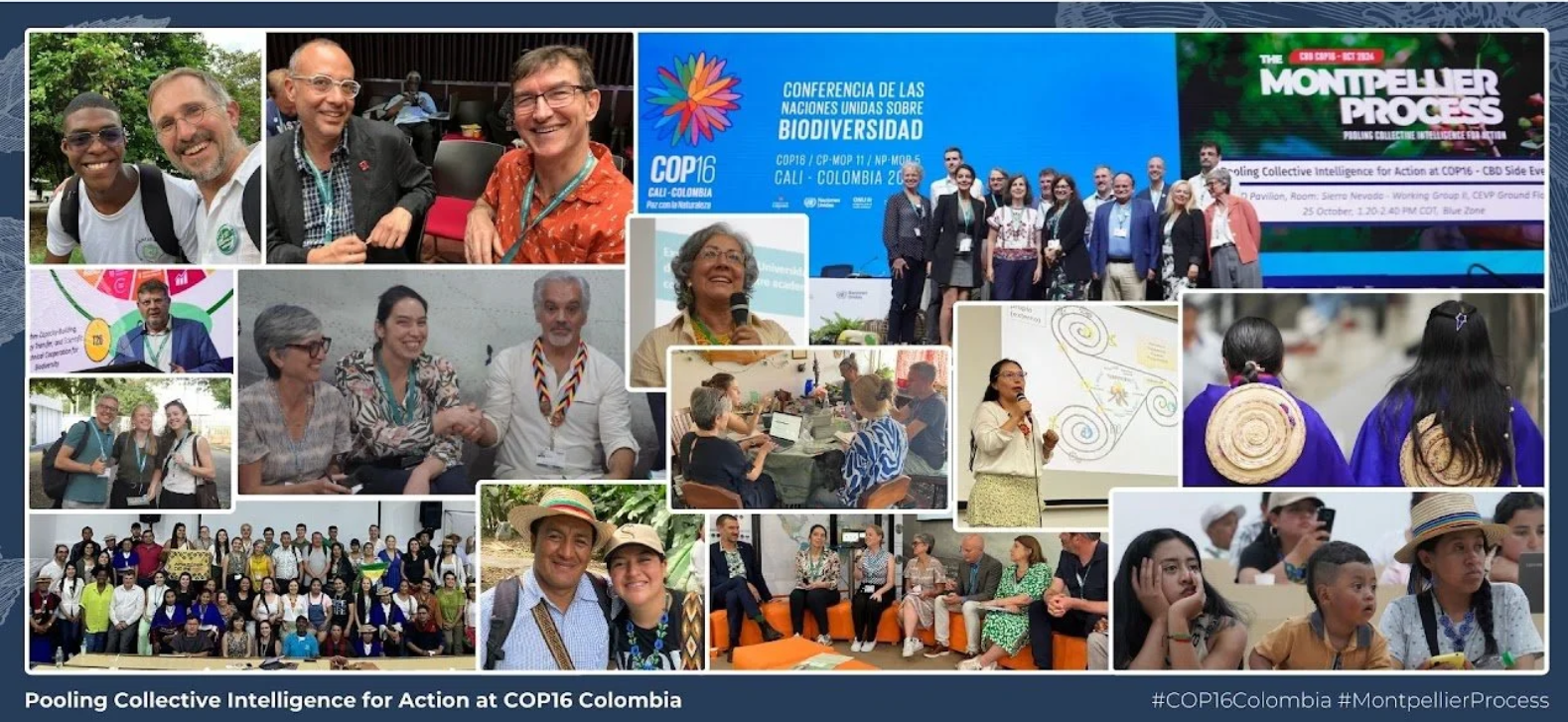
At COP16, the MP interacted with around 1200 participants spanning multiple gatherings over more than 10 connected events across the Blue and Green Zones. It mobilised Use Case Communities that provided concrete examples of food system transformation from implementation actors and highlighted strategies that maximise feed-care-protect synergies. Use Cases included Cities-Territories (São Paulo, Montpellier, Cali/Valle de Cauca), Countries (Colombia, Argentina, Brazil, Vietnam and Belgium), International Trade Policy (steered by the OECD and IDDRI), and Diverse Knowledge Systems (curated by the Universidad Nacional of Colombia with the involvement of the local indigenous communities of Missak and Ampiuile).
-
Montpellier Process COP16 Communiqué
The MP engaged with four action-driven communities, and developed Use Cases on Cities-Territories, Countries, International Trade Policy and Diverse Knowledge Systems.
This outcome document takes a deeper dive into the MP COP16 outcomes, harvesting outputs and insights to make sure progress is monitored in terms of both process and content, proposing a model for learning that the MP can use going forward.
The document is targeted at the MP Community, now stretching to almost 500 members, geographies and sectors along the knowledge-action continuum.