

The Montpellier Process - Nexus Action
2024-2025
The Montpellier Process, also known as Nexus Action, is a learning collective, community-owned process convened and curated by an alliance of partners redefining how we model effective, more iterative, and better coordinated Science-Policy-Society Interfaces across scales (global, national and local), across sectors (environment, health, people, agriculture, food) and across knowledge systems.
The collective convenes a global community bringing together local innovators, national leaders and international institutions, spanning knowledge systems from Indigenous expertise to cutting edge science, from farmers’ and fishers’ insights to consumer perspectives .
27 May 2025, Vienna - The Montpellier Process @SAM Conference
-
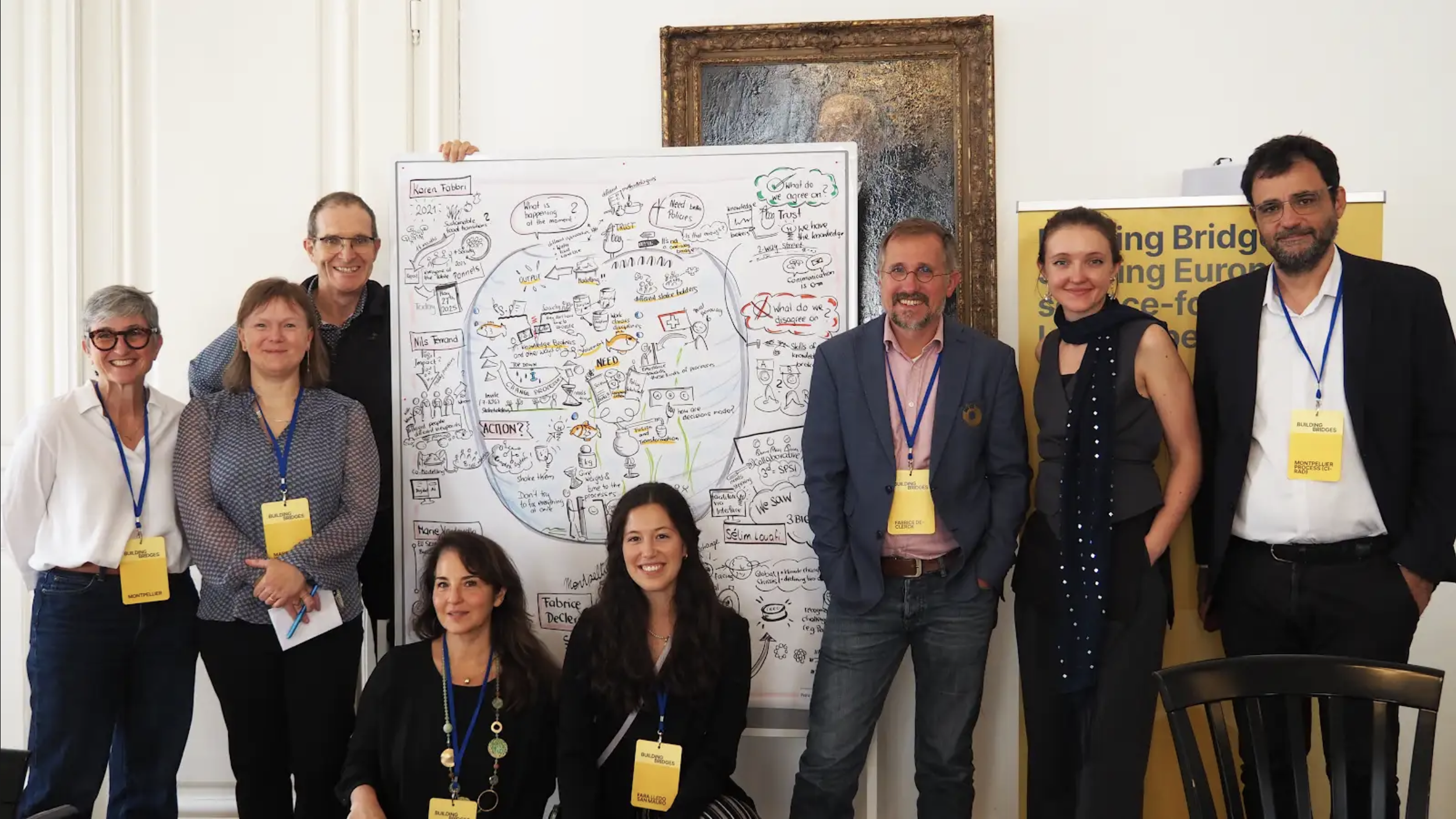
The Montpellier Process, together with Bioagora and INRAE made the case for progressive Science-Policy-Society Interfaces (SPSIs) capable of tackling interconnected feed-care-protect nexus challenges at the in-person Vienna-based SAM Conference of the Scientific Advice Mechanism to the European Union.
Drawing on real-world initiatives, the co-hosted side event ‘Making the Case: Forward-Looking Science-Policy-Society Interfaces for Tackling Nexus Challenges Across Scales, Sectors, and Actors’ explored practical tensions and opportunities in designing impactful, inclusive, and adaptive SPSIs.
-
After a short presentation and mapping of the three SPI cohost models to identify their synergies and differences, participants shifted into a directed fishbowl with 80 representatives from across science, policy and action. Supported by live visual sensemaking and note taking, the fishbowl probed the questions: why invest in interfacing when it’s so difficult—and what’s at stake if we don’t?
-
Key messages coming out of fishbowl discussion included:
Science–Policy–Society Interfaces are not self-organized. They require careful design to recognise divergence and move to alignment and action. Rather than smoothing over differences, effective SPSIs create risky-safe spaces that surface disagreement as a starting point for deeper alignment.
Future-fit SPSIs rely on collective intelligence and iterative engagement across all scales. Effective interfaces don’t trickle down. They are co-constructed across levels and actors, recognising that cities, communities, and often-overlooked actors (farmers, Indigenous Peoples, youth) are not just stakeholders, but system shapers. Strengthening these ecosystems is key to connecting local traction with global transformation.
The conventional role of science, knowledge and expertise needs to be revisited. We need a new narrative where the role of science is not only to provide evidence, but to produce knowledge that engages with and informs transformation, is inclusive of diverse knowledge systems, and proposes ways to navigate tensions and trade-offs.
Read more about the side event on Bioagora’s page.
March 25, Paris - Montpellier Process @Nutrition for Growth

-
The Montpellier Process (MP) made its mark at the Nutrition for Growth event in Paris, building on the outcomes of the CBD COP16 dialogue series and paving the way toward UNFCCC COP30. At this pivotal moment, the MP brought together a dynamic knowledge-to-action community, focused on unlocking local-to-global-to-local “Lo-glo-Lo” action to create nutrition-driven impact. The aim at Nutrition for Growth was to explore how Nutrition Goals and Targets could be translated into actionable steps for greater ownership by those responsible for their implementation. The MP also sought to understand the crucial role of knowledge communities, particularly in the nutrition field, and to examine the synergies and tensions between nutrition targets, biodiversity and climate goals.
-
At Nutrition for Growth, the MP amplified its presence through several gatherings and events across Paris, starting with the MP side event at CIRAD Headquarters in coordination with Agrinatura - SASi-SPi and the AgroEcology Coalition in the context of a Science-Policy Interfaces Day hosted by CIRAD. N4G was also an opportunity to reconvene the International AgriFood Trade Policy Community originated at COP16 and hosted by the OECD Headquarters. Throughout the week, the MP brought its voice ind SPI message in several other spaces, from the Science Conference at the Agence Francaise du Developpement to the ‘Everyone’s Business’ Private Sector event hosted by WBCSD, to the Village of Solutions.
October 24, Cali - Montpellier Process @COP 16

-
The Montpellier Process is a collective, community-owned process convened and curated by an alliance of partners whose aim is to demonstrate more effective, more iterative, and better coordinated Science-to-Policy Interfaces (SPIs) across scales (global, national and local), across sectors (environment, health, people, agriculture, food) and across knowledge systems. It adopts Food Systems as an entry point to engage across the feed-care-protect nexus. Through its presence at Biodiversity COP16, the MP had the opportunity to amplify its message: the Feed-Care-Protect nexus challenges will only be addressed when agri-food systems solutions are applied. Food systems transformation best contributes to sustainable development when aligned to the Global Biodiversity Framework and targets just as the targets will only be met if they are incorporated into Food Systems strategies and pathways. This takes effective and inclusive science-policy-society interfacing spaces, starting from where the implementers are, so that knowledge communities can play an authentic role.
-
At COP16, the MP interacted with around 1200 participants spanning multiple gatherings over more than 10 connected events across the Blue and Green Zones. It mobilised Use Case Communities that provided concrete examples of food system transformation from implementation actors and highlighted strategies that maximise feed-care-protect synergies. Use Cases included Cities-Territories (São Paulo, Montpellier, Cali/Valle de Cauca), Countries (Colombia, Argentina, Brazil, Vietnam and Belgium), International Trade Policy (steered by the OECD and IDDRI), and Diverse Knowledge Systems (curated by the Universidad Nacional of Colombia with the involvement of the local indigenous communities of Missak and Ampiuile).
-
Montpellier Process COP16 Communiqué
March 24, Montpellier - Montpellier Process Gathering

-
Initiated in early 2021, the Montpellier Process has established a collaborative and safe working space across leading International Panels that facilitates collective intelligence, strengthening the science-policy and science-society interfaces key to unlocking sustainable, equitable and just development, where food systems are a catalytic transformation lever.
The Montpellier Process is reconvening the involved scientific community in March 2024, inviting a larger and broader coalition of partners.
-
In March 2024, the Montpellier Process reconvened for a two-day event to address global challenges through pooling collective intelligence. Hosted by the University of Montpellier and CGIAR, the event gathered international scientific communities to prepare joint messaging and activate cooperation across International Panels and Science-Policy Interfaces. The agenda included supporting learning communities of practice to optimize expertise at all levels, defining better collaboration for contributing to the UN International Decade of Sciences for Sustainable Development (2024-2033), and increasing the representation of marginalized knowledge systems.
Day 1: Focused on transitioning from knowledge to collective intelligence through plenaries, interactive discussions, and working sessions on local and national food system transformation pathways.
Day 2: Concentrated on actionable interfaces, designing effective decision-making connections, and refining joint messages to support sustainable development goals.
-
Areas of impact: Science-to-Policy Interfaces, Environmental Sustainability, Food Systems and Agriculture
Outcomes:
Click here to read more about the Montpellier Process: MP March 2024 Outcome Document